| After finding the problem to be a
malfunctioning CAS in my daughter's Z I found that the CAS can be
rebuilt. This post is how to perform preventive maintenance on the
CAS assembly or how to save a malfunctioning CAS as I did to the one
we were having a problem with.
Here is my first post regarding finding the problem with the CAS.
>
I just wanted to share this in case anyone was to run into the
same problem. My daughter's Z was having a problem where once the
motor got hot it would run REAL rough. When this occurred it was
almost impossible to get the car started after shutting it off. From
dead cold it would start ok. The car had been having a high idle
problem even when you adjusted the idle adjustment screw all the way
in so I decided I would start at servicing the IAA and AAC using the
info at this link.
[ http://home.swipnet.se/e-solutions/IdleTech.html
]
There are three connectors involved in this and all three were
heavily corroded. After thoroughly cleaning all the connections and
completing the rebuild on these items the idle adjustment worked
flawlessly but after the motor got hot it was right back to the REAL
rough problem again. The engine ran and sounded as if either the
timing was out or one or more injectors were cutting out. A timing
light revealed the timing was ok when cold but became very erratic
when the engine got hot. To rule out if one or more injectors
stopped operating I used my engine stethoscope to listen to each of
the injectors and I could hear all them clicking away just fine (a
quick way to tell if they are operating but not a way to tell if
they are spraying properly).
To make sure the PTU wasn't failing when it got hot I swapped in
a known good PTU but the problem was still there. I had already
pulled the connector to the CAS and checked it for corrosion but it
was very clean. Not able to see the inside of the connector on the
CAS I removed the CAS to inspect it and my first impulse was to spin
the shaft and WALA! The shaft did not spin freely at all. It had a
very grinding feeling. Luckily I had a good CAS lying around,
installed it, adjusted the timing and idle and all was fine. From
how bad the CAS shaft rotation was I was surprised it even worked at
all. <
On to the preventive maintenance procedure.
Warning: Please read this complete procedure before attempting
any repair or maintenance on the CAS.
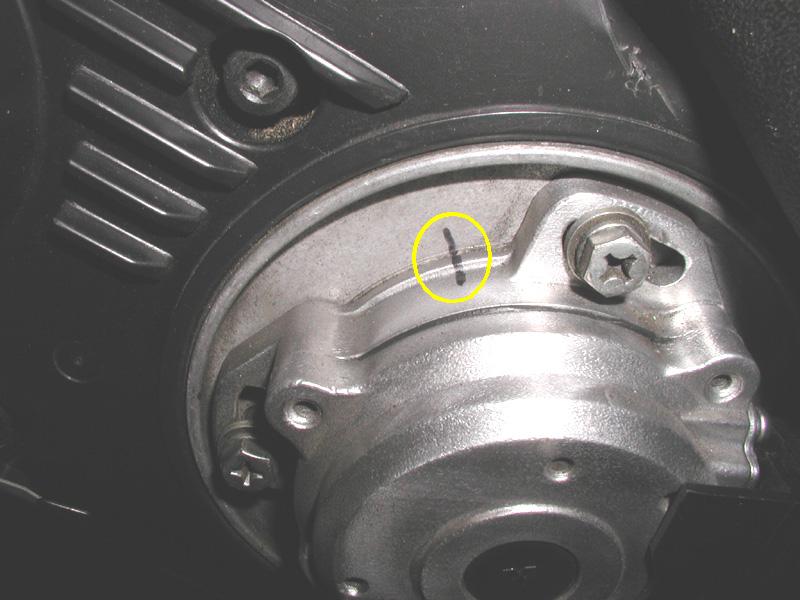
The first thing to do is mark the position of your CAS before you
remove it from your motor. You can do this by marking it with a
sharpie as I did in the picture below. It is not necessary to
disconnect your battery when disconnecting the CAS as all power is
removed from the CAS when the engine is turned off. Disconnect the
connector to the CAS and remove the three 10mm screws from the
slotted holes. When you attempt to pull the CAS out it may feel like
a spring is pulling it back in. This is normal and is due to a
suction force created by a vacuum space between the cam shaft and
the internal shaft of the CAS by lubricating grease. If this happens
just pull real hard until it pops out.
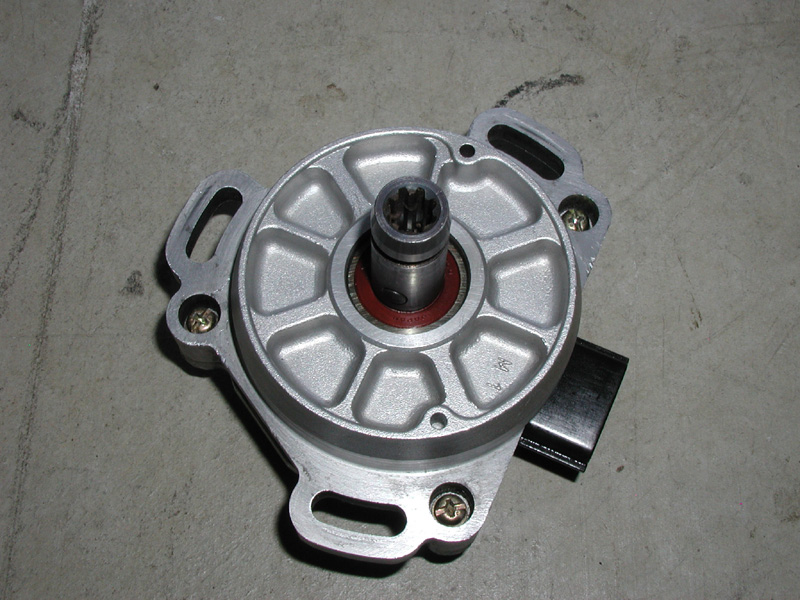
Once removed sit it down with the shaft pointing up as in the
picture below. In this position we will call the two halves the
upper and lower. Using a number 2 Philips head screw driver remove
the three short Philips head screws that hold the CAS together. Use
a small flat tip screw driver and working around the CAS pry the two
halves apart.
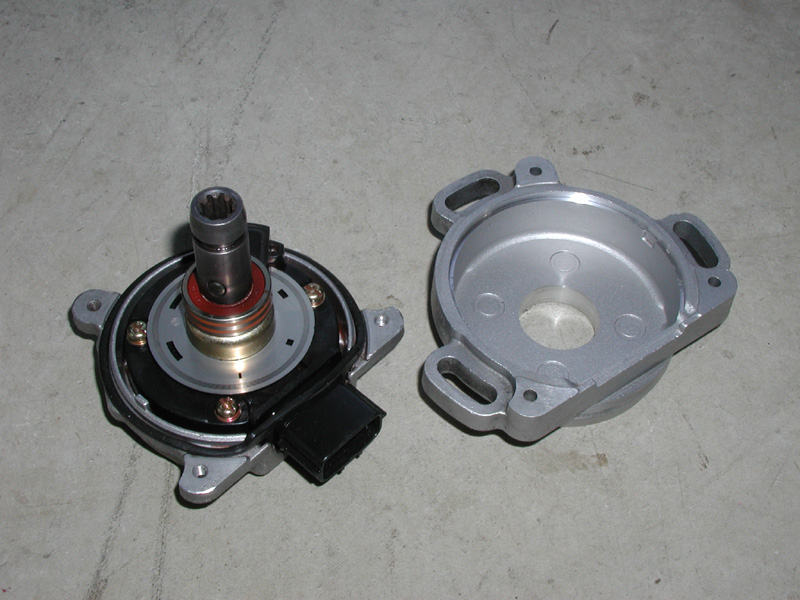
Once the two halves have been separated you will see a rubber
seal which goes around the CAS and around the connector. DO NOT
attempt to remove the rubber seal from around the connector. It is
OK to lift the rubber seal from around the CAS to clean the area
around it. The picture below is how the CAS should look once the two
halves have been separated (this picture is of a partially cleaned
CAS).
There are two bearings that suspend the internal components
within the housing. One is on the shaft that fits into the hole of
the upper half and one is pressed into a recessed area on the lower
half. The internals are held in place by three long Philips head
screws. It is not necessary to remove these screws. If you do remove
these screws you will find that you can not separate the internal
components from the lower half without the possibility of damaging
the CAS due to the lower bearing being pressed into the lower half.
Leave the internals attached to the lower half for the rest of this
procedure.
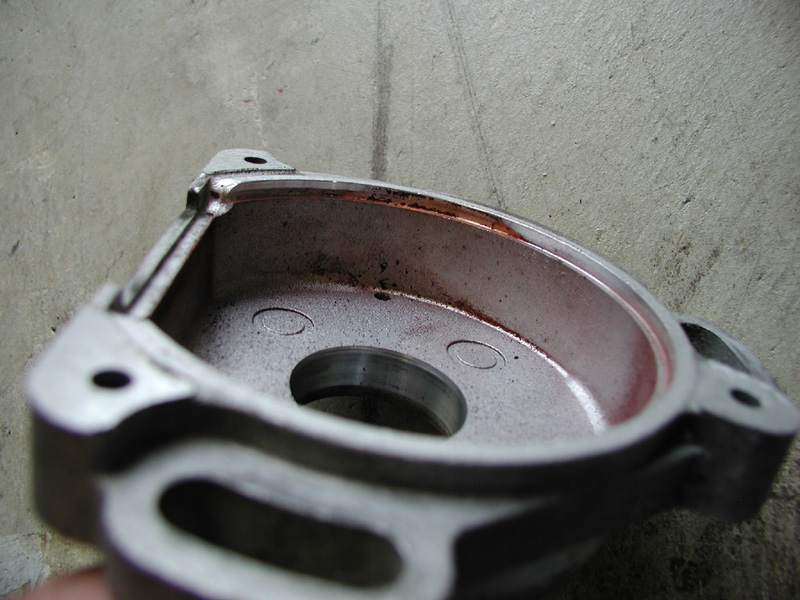
In the picture below of the upper housing you can see a brownish
dust which is dry debris from the breakdown of the sealed bearings
which escapes between the bearing casing and the shaft.
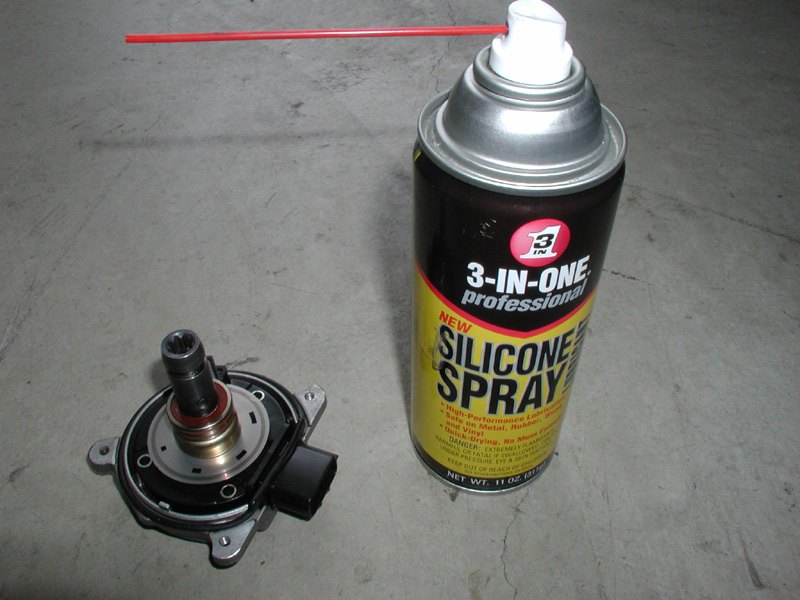
Thoroughly clean the housing using a silicone lubricant such as
the type in the picture below. DO NOT use WD40. WD40 contains
solvents which will break down the lubricants which are needed to
insure continuous operation of the CAS bearings.
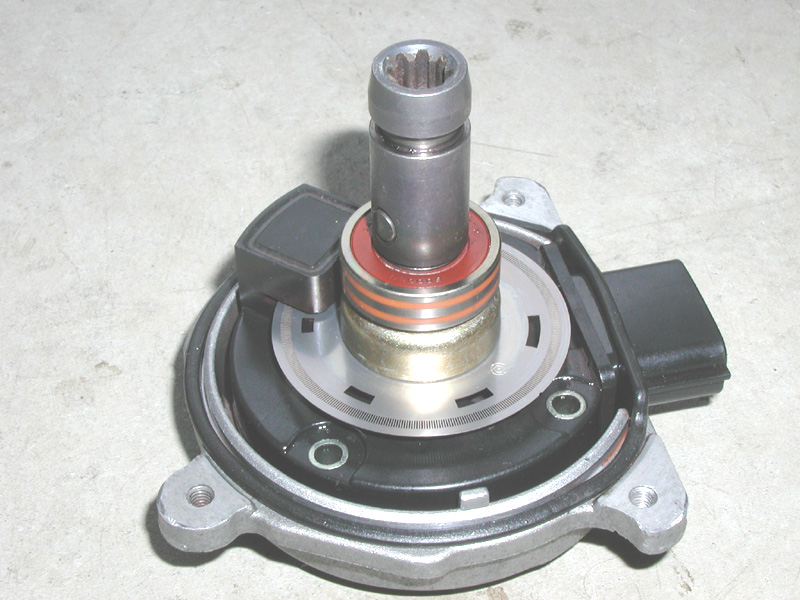
I will explain some things in this next picture below. The
connector to the CAS is a part of the complete molded interior
plastic piece (in my picture I have removed the three long Philips
head screws from this piece). If you have a CAS with a broken
connector it can not be repaired by swapping a connector from
another CAS. The CAS operates by photo electric sensors. There are
transmitters and receivers which are in the upper and lower portions
of the raised square (to the left in this picture) which is a part
of the complete molded plastic piece which is also a part of the CAS
connector (to the right). There is a steel disc which has a series
of continuous small holes around the outside edge and six different
size holes toward the inside of the disc. When the disc rotates
through the square which contains the sensors, light from the
transmitters pass through the holes to the receiver sensors on the
opposite side and send pulses to the ECU to initiate the process of
triggering both the injectors and the firing the coil packs. The
holes in this disc can become covered in debris causing disruptions
in the signals being sent to the ECU. The disc in this picture was
covered in the dry dusty brownish debris as seen above in the upper
housing picture before I cleaned it.
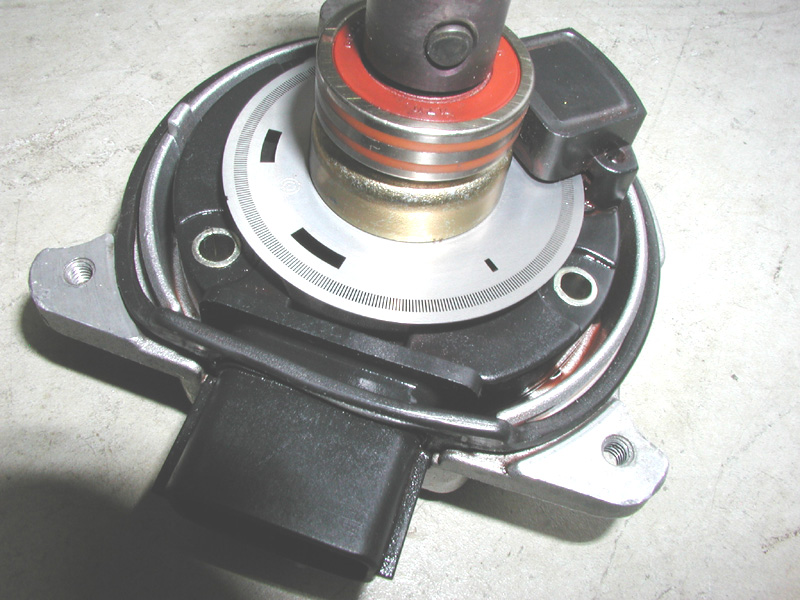
In the picture below you can see the brownish debris in the
bottom of the lower housing. To clean and lubricate the inside area
of the lower housing spray a good amount of silicone spray between
the small opening around the internals and lower housing until the
lower housing is literally full of silicone spray liquid. Rotate the
shaft a few times and then drain the liquid onto a rag. Repeat as
many times as it takes until all signs of debris are gone and the
liquid comes out clean. Spray a small amount of silicone spray
between the top of the upper bearing and shaft and again rotate the
shaft a few times. Lay the housing on a rag so that the top of the
shaft is pointing down toward the floor at an angle and let it sit
for a few minutes to allow as much liquid as possible to drain from
the housing. When doing this place it in a position where the square
piece which contains the sensors is toward the top to help keep
liquid away from the sensor area. Once that is done apply one or two
drops of 10w30 motor oil to the top of the upper bearing between the
bearing and shaft and wipe dry.
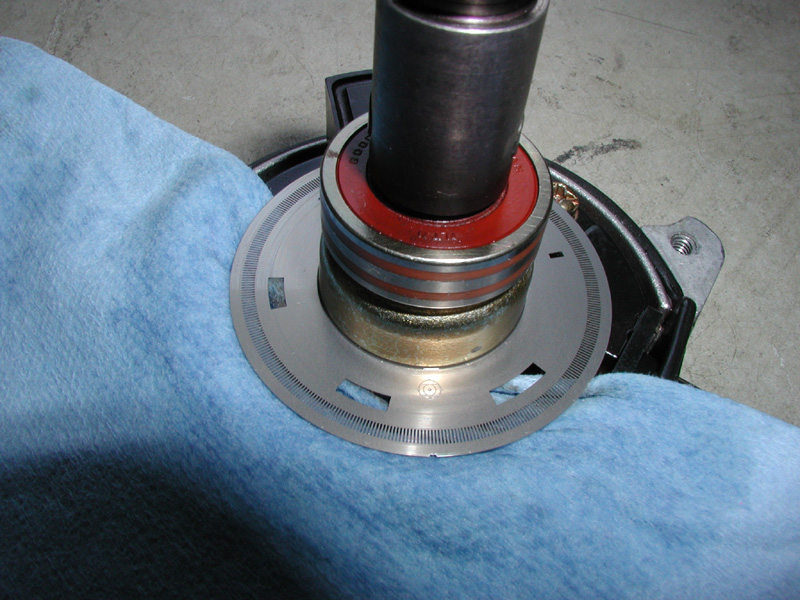
In the picture below I used a shop towel soaked with silicone
lubricant and slipped it under the disc and applied a small amount
of downward pressure to the disc while rotating the shaft to clean
the under side of the disc. Then I used a dry shop towel to remove
any excess lubricant. In this picture you can see one of two cuts in
the very outside edge of the disc. This is not damage. This is the
way it was manufactured. If you look close (in reality) you can see
it is a machine square cut on opposite sides of the disc.
Once the CAS has been cleaned, reassemble it, reinstall it to the
motor and reconnect the connector to the CAS. Cleaning the CAS is
very simple. This preventive maintenance procedure will certainly
help prolong the life of your CAS and help to keep your Z running
smooth.
www.mytwinturbo.com

|










 CAS
Preventive Maintenance. - DVDBURN (MD) 03:25:31
08/02/06
CAS
Preventive Maintenance. - DVDBURN (MD) 03:25:31
08/02/06